
How Long Does It Take to Read 15 Pages? A Time Guide
Estimate how long it takes to read 15 pages using page density and your reading pace, with English WPM, Chinese and Japanese CPM examples, and study-time tips.
Reading 15 pages takes 15–30 minutes if each page contains 250–500 words and you read at 250 words per minute (WPM). That is a calculated example, not a universal average. Dense chapters, unfamiliar vocabulary, and note-taking can extend the session. For Chinese or Japanese text, estimate from characters per minute (CPM) instead of reusing an English word count.
The useful question is whether your next 15 pages fit the time you have. Here is how to calculate that without treating every book as the same reading task.

A quick estimate for 15 pages
Use this formula for English text:
Reading time in minutes = 15 × average words per page ÷ your WPM
At an assumed pace of 250 WPM, the calculation gives:
- 250 words per page: 3,750 words total ÷ 250 = 15 minutes.
- 350 words per page: 5,250 words total ÷ 250 = 21 minutes.
- 500 words per page: 7,500 words total ÷ 250 = 30 minutes.
These page densities and the pace are illustrative inputs, not measured averages for novels or textbooks. Count a few pages of your edition and substitute your own rate. If you know the exact word count of the whole selection, divide that count by WPM directly.
For context, Marc Brysbaert’s 2019 meta-analysis estimated adult English silent-reading averages of 238 WPM for nonfiction and 260 WPM for fiction. Those group estimates are not a promise about an individual assignment. Our average reading speed guide explains how to interpret benchmarks.
Why the same 15 pages can take twice as long
A page is a unit of layout. Larger type, generous margins, dialogue, and illustrations leave room for fewer words. Small type and long paragraphs can put much more text on the same number of pages.
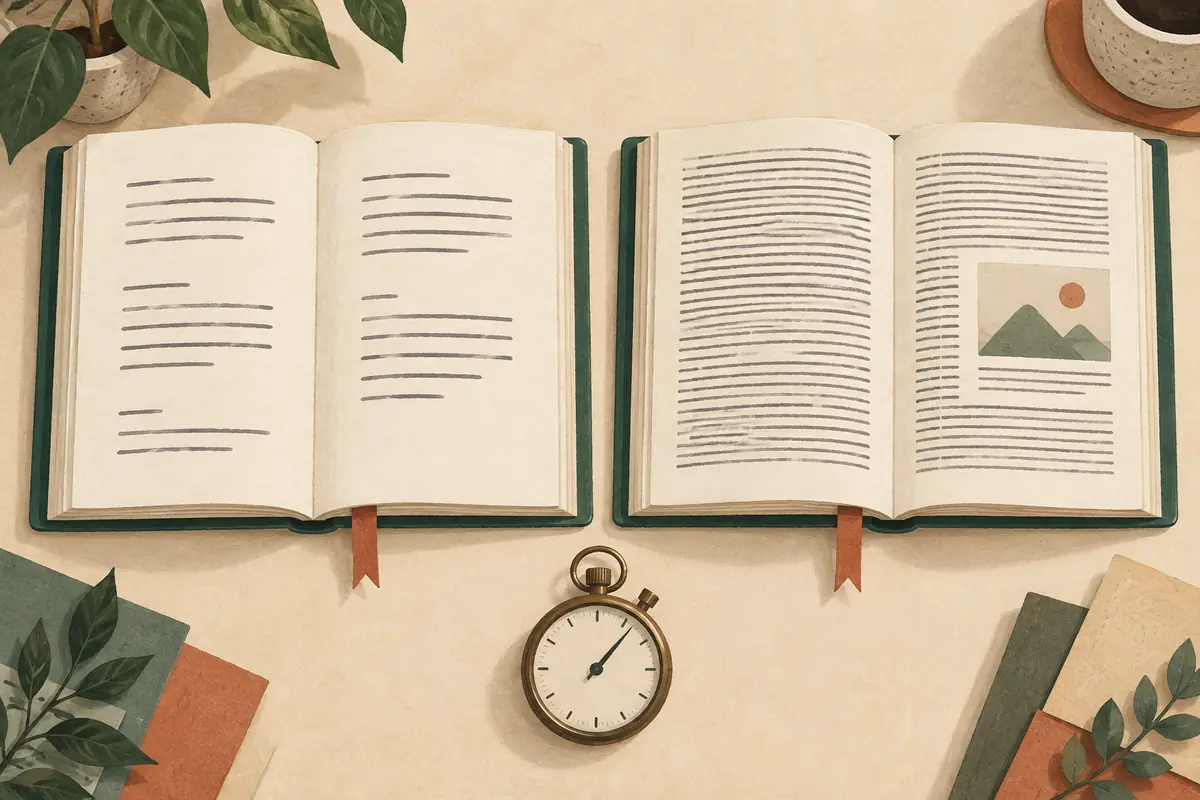
Equal page counts can contain different amounts of text. Illustration, not measured book data.
Suppose two books contain 250 and 500 words per page. At the same 250 WPM, their 15-page sections would take 15 and 30 minutes respectively. The reader has not become slower; the second section contains twice as many words.
Density is only one variable. A short equation or unfamiliar definition can require more work than a long paragraph of familiar dialogue. Treat a word-based estimate as time for reading the prose, then account for the rest of the task.
Find your own estimate in three steps
1. Sample the pages you will actually read
Choose three representative pages from the 15-page section: one near the beginning, one in the middle, and one near the end. Count their words and average the results. Include a diagram-heavy page if diagrams occupy much of the assignment; avoid sampling only the densest text.
For a rough manual count, average the words in a few typical lines and multiply by the number of text lines. This is an approximation, so round the final time to whole minutes rather than reporting seconds.
2. Measure a comparable reading pace
Use a passage that resembles the assignment in language and difficulty. Read at a pace at which you can explain the main point afterward. Divide the words you actually finished by active reading minutes; exclude interruptions.
You can measure your reading pace with LumenRead using a reviewed passage or pasted text. It offers reading-speed results and, when AI questions are available, a short comprehension check. Three questions are a limited check, not proof that you have mastered a chapter. If questions are unavailable, summarize the passage yourself.
A paced word or sentence session is useful practice, but its speed may differ from normal page reading. Cross-check your estimate on the actual book. See how to measure reading speed accurately for a repeatable process.
3. Turn the calculation into a time block
Assume your pages average 350 words and a comparable reading sample gives 210 WPM:
15 × 350 ÷ 210 = 25 minutes of reading
If you separately reserve five minutes for notes and five for recall, schedule 35 minutes. Those extra ten minutes are your planning choice, not a research-based allowance. Adjust them to the task rather than applying a fixed percentage to every book.
Reading 15 pages in Chinese or Japanese
Use the same calculation with a consistent character count:
Reading time in minutes = 15 × counted characters per page ÷ your CPM
LumenRead counts Han characters for Chinese-primary text, and Han plus kana for Japanese-primary text, excluding punctuation and whitespace. Count the sampled pages the same way. An English WPM figure cannot simply be relabeled as CPM.
- Chinese example: assume 600 counted Han characters per page and a measured pace of 450 CPM. Then 15 × 600 ÷ 450 = 20 minutes.
- Japanese example: assume 500 counted Han and kana characters per page and a measured pace of 400 CPM. Then 15 × 500 ÷ 400 = 18.75 minutes, or about 19 minutes.
These are hypothetical calculations, not Chinese or Japanese population benchmarks. Neither example implies that one language is faster to read. Layout, counting conventions, text difficulty, and language proficiency all affect the comparison. For Chinese material, the Chinese reading speed test provides a CPM-focused starting point.
How much time should you allow for 15 textbook pages?
Separate reading the text from completing the study task. A chapter may require checking a diagram, solving a worked example, looking up terminology, or explaining a process from memory. A word count does not measure those activities.
If the assignment is due soon, try this practical check:
- Read three representative pages with the level of note-taking the assignment requires.
- Record elapsed time, including the study activities you need to repeat.
- Multiply by five to estimate a comparable 15-page workload.
- Add time for any remaining exercises or difficult sections that the sample did not include.
For example, three pages that take nine minutes suggest about 45 minutes for 15 similar pages. This assumes a steady workload; it is a planning estimate, not a deadline you must beat. If the next section introduces a new concept, reassess the estimate.
Our guide to reading textbooks without losing comprehension covers previewing, reading, and recall in more detail.
Frequently asked questions
Can I read 15 pages in 15 minutes?
Yes, under some conditions. Fifteen pages containing 250 words each require 250 WPM to finish in 15 minutes. At 500 words per page, the same deadline requires 500 WPM. Check the actual density and whether you can explain what you read before choosing that target.
Is taking an hour to read 15 pages too slow?
The page count alone cannot answer that. An hour spent on dense material, a second language, detailed notes, or problem-solving describes a different task from casual reading. Compare similar material with the same comprehension goal rather than judging yourself against a generic page rate.
How long does it take to read 15 pages aloud?
Use your speaking rate instead of silent-reading WPM. For an illustrative 3,750-word passage at 150 spoken words per minute, the calculation is 25 minutes, before additional pauses. Rehearse a representative section if timing matters.
What if I only know my pages per hour?
Use minutes = 15 ÷ pages per hour × 60. At 30 pages per hour, 15 pages take 30 minutes, provided the material and reading purpose are comparable. The pages-per-hour guide explains how to build that personal rate.
Plan your next 15 pages
Count a representative sample, use a pace measured on similar material, and reserve separate time for study activities. After the session, check whether you can state the main idea and a supporting detail. Use the actual time and recall quality to improve the next estimate.
Start with a free reading speed test, then compare that result with a few pages of the book you want to finish.