
How to Increase Reading Speed and Comprehension
Increase reading speed and comprehension together with a measured practice loop that raises pace in small steps while protecting understanding, completion, and recall.

To increase reading speed and comprehension at the same time, practice at a slightly challenging pace, check what you understood, and adjust. Improving reading speed without losing comprehension is a training problem, not a trick. The goal is not to suppress every pause or eye movement; it is to reduce avoidable hesitation while keeping enough attention to build meaning from the text.
How to increase reading speed and comprehension together
The method fits in one sentence: raise your pace in small, measured steps, and gate every step with a comprehension check. Speed that arrives without understanding is skimming, and steady understanding without pace gains means the target is ready to move up. The sections below break that loop into parts — baseline, target size, reading units, and guardrails — and the research notes explain which popular shortcuts do not work.
Start with a reliable baseline
Choose material you would genuinely read. Measure active reading time, completion, and a short comprehension check. One fast session is noisy; use several similar sessions before deciding that your baseline has changed.
Record the context:
- text type and difficulty;
- English WPM or Chinese CPM;
- completion percentage;
- comprehension result;
- whether you skipped ahead or reread;
- whether the session was unusually short.
Increase pace in small steps
Set the next target only a little above a pace you can already sustain. If comprehension drops sharply, return to the previous range. A smaller repeatable gain is more useful than one impressive number produced by skimming.
LumenRead's pace control can guide attention, but it should remain adjustable. Technical material, unfamiliar arguments, and important instructions deserve slower reading.

Read in meaningful units
Word-by-word display can help establish rhythm. Sentence mode provides more context and may suit readers who already recognize common word patterns quickly. Neither mode is universally superior. Compare them on similar text and keep the one that supports both flow and understanding.
What does not improve reading speed
Before adding techniques, it helps to know which popular ones do not hold up. A 2016 review in Psychological Science in the Public Interest, So Much to Read, So Little Time, examined speed-reading claims and found no evidence that readers can dramatically multiply their rate while keeping normal understanding. Three claims deserve specific skepticism:
- Eliminating subvocalization. Inner speech during reading is a normal part of language processing, not a brake to remove. Silencing it by force does not produce durable gains.
- Suppressing regressions. Looking back is sometimes exactly the right response to a difficult sentence. Training yourself never to reread trades understanding for an appearance of speed.
- Reading in ever-larger visual spans. Eye-movement research shows the readable span is limited by language processing, not by eye muscles. Widening it on command mostly produces skimming.
The gains that do replicate look modest and boring: more reading experience, better vocabulary and background knowledge, and matching pace to purpose. That is good news, because those respond well to the practice loop below.
Do not fight normal eye movements
Reading includes fixations, rapid movements between them, and occasional regressions. Keith Rayner's research review, Eye movements in reading and information processing, explains why eye movements are part of normal language processing. Claims that readers should eliminate all regressions or absorb entire pages at once are not a sound practice target.
Instead, reduce avoidable rereading by improving attention and choosing a pace appropriate to the text. Rereading a difficult definition can be useful; repeatedly losing your place because the target is too fast is a signal to adjust.

Use comprehension as the guardrail
After each session, explain the main claim in your own words before looking at the score. Then review the questions and any explanation critically. AI-generated questions can be imperfect, so do not treat one disputed item as proof that the session failed.
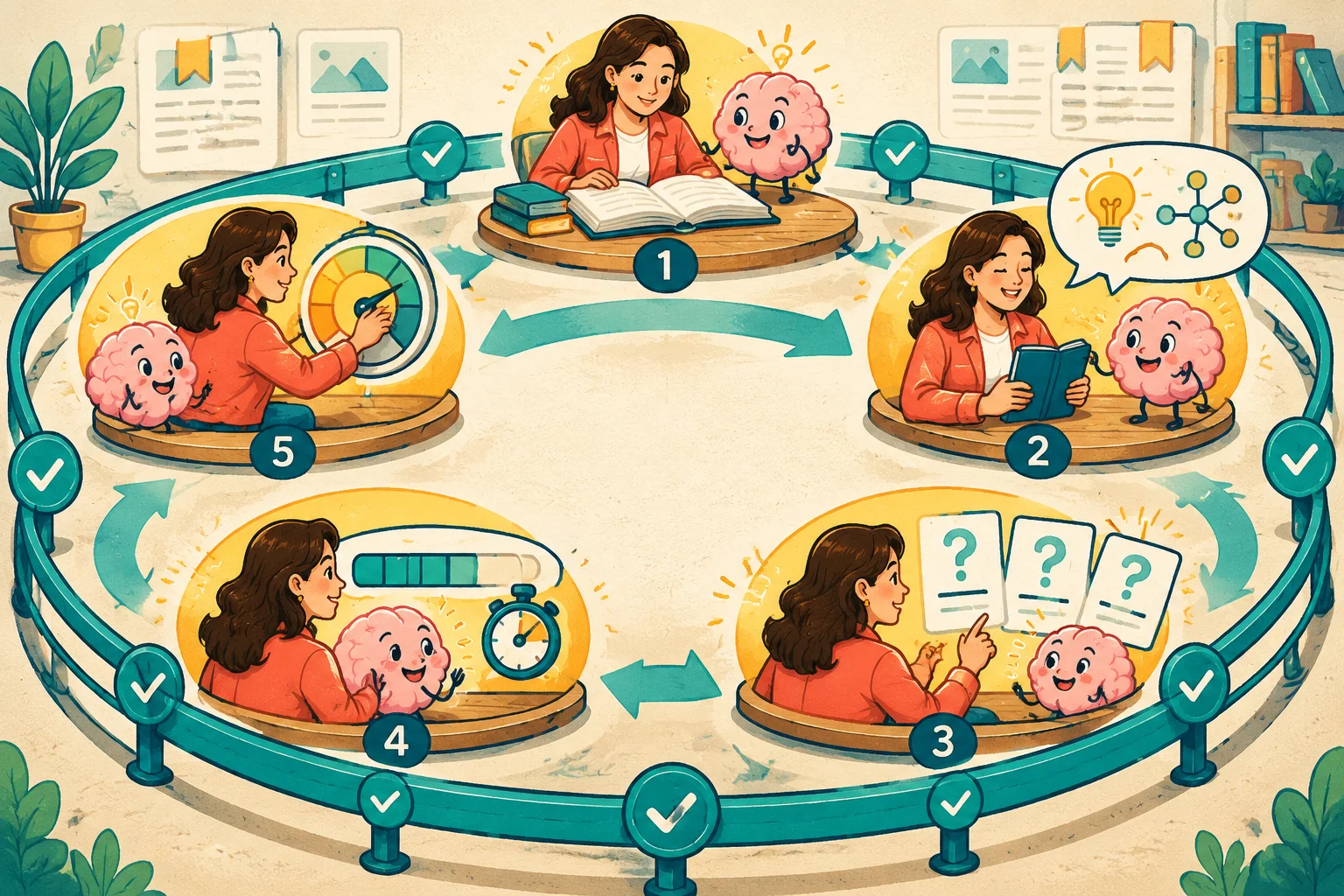
A practical loop is:
- Read at a controlled pace.
- Summarize the central idea from memory.
- Answer the comprehension questions.
- Review completion and active time.
- Raise, keep, or lower the next target.
Calibrate the next target
Use average reading speed benchmarks with their limitations as context, not a grade. Check how pace and comprehension interact before deciding that a higher WPM target represents progress.
How long improvement takes
Sustainable pace improves over weeks of regular practice, not one dramatic session. Early progress often comes from removing distractions and settling on a repeatable routine rather than from any new skill. Plateaus are normal; they usually mean the current material is now easy, which is the signal to practice on slightly harder text.
Treat the timeline as feedback, not a schedule. If completion and comprehension stay stable while pace creeps up over a month of sessions, that is real improvement, whatever the absolute numbers.
Practice for the reading you actually do
Transfer is more likely when practice resembles the real task. If you want to read research papers more effectively, practice with research-style prose. If you want faster daily news reading, use news-length articles. Do not expect drills on very easy text to transfer automatically to dense professional material. For a full setup walkthrough, see how to practice reading with your own articles.
Frequently asked questions
How long does it take to increase reading speed and comprehension?
Meaningful, repeatable gains usually appear over weeks of consistent practice with comprehension checks. One-week jumps measured only on easy text usually reflect skimming or familiarity. Track pace, completion, and comprehension together across several sessions before calling the change real.
Should I stop subvocalizing to read faster?
No. Inner speech is part of how skilled readers process language, and research on speed reading finds no support for eliminating it as a way to dramatically raise comprehension-preserving pace. If your inner voice feels slow, a slightly higher practice target with comprehension checks is a better response.
Do speed reading apps work?
Apps can help with the part that works: structured practice at a slightly challenging pace with measurable feedback. Be skeptical of claims of multiplying your speed while keeping full understanding, which controlled research does not support. Measure any app's effect with your own completion and comprehension results.
Why did my reading speed drop this week?
Common causes are harder material, an unfamiliar topic, fatigue, a different device or display mode, and reading for a stricter purpose such as study instead of orientation. A drop under different conditions is not regression. Compare only sessions with similar material and purpose.
Start a controlled reading practice session and make the next pace decision from both speed and comprehension, not speed alone.