
How to Practice Reading With Your Own Articles
Build a reading practice routine from articles you actually need to read, using library passages, pasted text, or uploaded txt and md files, with pace and comprehension you can compare.
The most effective reading practice material is the reading you already need to do. A reviewed passage from a library, an article pasted from your inbox, or a textbook chapter saved as a .txt or .md file can all become a measurable practice session: read at a set pace, answer a short comprehension check, and compare the result with earlier sessions on similar material.
Generic drills on someone else's paragraphs rarely transfer to the dense report or long essay you actually face. This guide shows how to turn your own articles into a repeatable practice loop.
Why your own articles beat generic drills
Practice transfers best when it resembles the real task. Three reasons follow from that:
- Same vocabulary and structure. Practicing on research-style prose builds the exact recognition you need for research-style prose. Comfort with one genre does not automatically carry to another.
- Real stakes, real attention. An article you genuinely need to read produces the same focus conditions as your daily reading, which makes the measured pace meaningful.
- Fair comparisons over time. Similar material across sessions turns your results into a trend instead of a collection of one-off numbers.
Where to get practice texts
You have three practical sources, and each serves a different purpose:
- Reviewed library passages. A curated catalog is the cleanest starting point: texts are already checked for length and difficulty, so results stay comparable across sessions. Use one difficulty tier until your baseline is stable.
- Pasted text. Copy an email draft, a report section, or a news article into the intake. This is the fastest way to practice on exactly the kind of text you face daily.
- Uploaded .txt or .md files. Save a chapter or paper as plain text and upload it. Treat Markdown as plain text — the words are counted, not rendered.
Aim for a passage you can finish in a few minutes. A one-paragraph snippet produces noisy numbers, and a full book chapter dilutes a focused session; split long documents into scene- or section-sized pieces.
Set up a comparable session
Before reading, decide the two settings that make results comparable:
- Display mode. Word mode highlights single words and builds rhythm; sentence mode keeps more context and suits readers who already recognize word patterns quickly. Pick one mode for a block of sessions instead of switching every time.
- Target pace. Set it slightly above what feels automatic. If you cannot state the main idea afterward, the target is too high; lower it instead of skimming.
During the session, only visible active reading time counts — switching tabs pauses the clock. Finish at least most of the text; a stopped session measures the exit, not your pace.
Reread the same article on purpose
Rereading is a simple, evidence-based addition. The U.S. National Reading Panel's review found that guided repeated reading of accessible passages improves fluency and comprehension, with the strongest evidence for developing readers reading aloud with feedback. Adults reading silently can borrow the same structure: read a passage once, then reread it at a slightly higher pace and confirm the summary still holds.
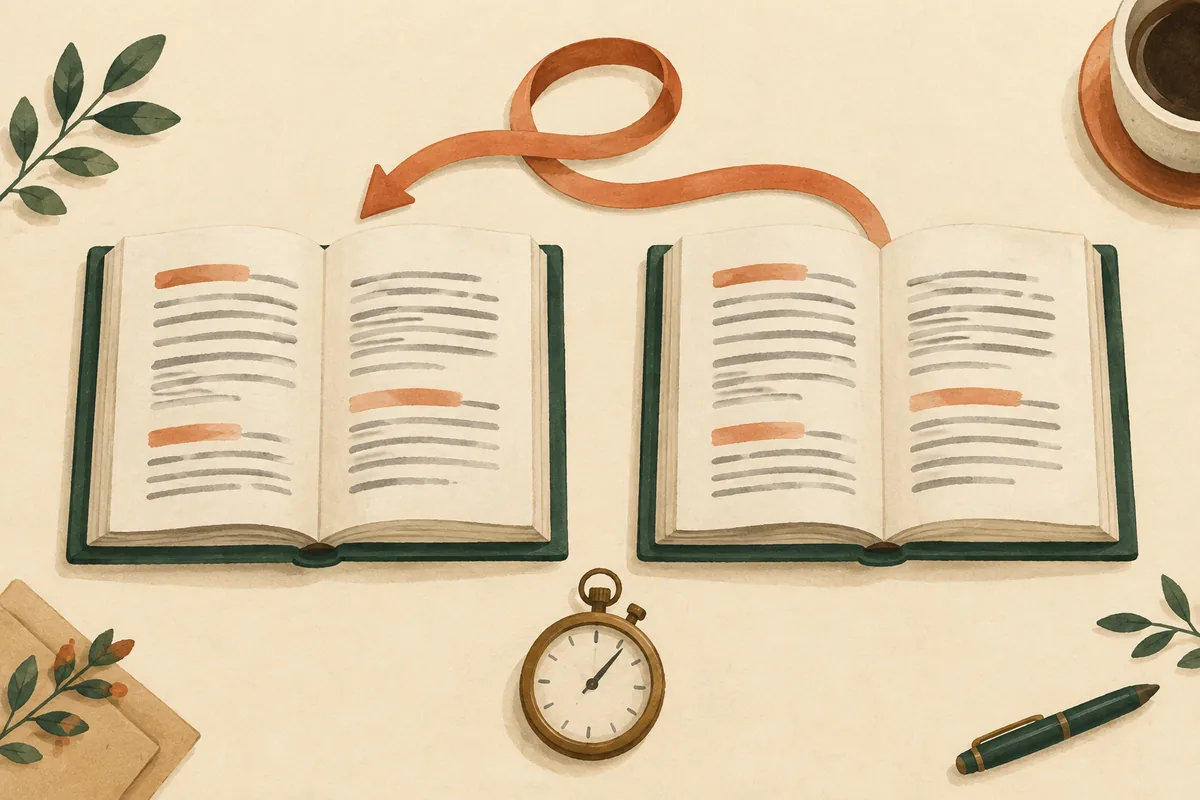
Rereading the same passage at a higher target is a structured drill. Illustration, not measured data.
Expect the gain on a reread to be larger than the gain on brand-new text — familiarity, not a new skill, explains most of it. The measured way to raise reading speed is to move the target up gradually across different articles once rereads feel easy.
Check comprehension every time
A pace without a check is just a stopwatch reading. After each session, say the main claim from memory before looking at any score, then answer the comprehension questions. AI-generated questions are a short check, not a full exam — and when question generation is unavailable, your own one-sentence summary is the fallback, so practice never blocks on it.
If pace climbs while answers get worse, you are skimming. Read how speed and comprehension trade off before deciding that a higher number means progress.
Build a small weekly rhythm
Three short sessions beat one long one:
- One easy session on familiar material to warm up and confirm your baseline.
- One typical session on text that matches your actual workload.
- One stretch session slightly above your current pace, with the comprehension check as the gate.
Keep material, mode, and purpose constant within each slot. After a few weeks, compare sessions within the same slot — that is your progress curve. For a structured way to run the sessions themselves, see how to use AI for reading tests and training.
Your text stays yours
In LumenRead, pasted and uploaded text lives in your browser for the current session. It is not stored in any database, it never enters analytics, and it is sent once — only to generate the comprehension questions. Uploaded file names are used as a local title suggestion and are not logged. Close the tab and the text is gone.
Frequently asked questions
What file types can I use for practice?
Plain text formats: paste text directly, or upload .txt and .md files. For PDF or DOCX material, copy the text out and paste it — the words are what matter for a reading session, not the original file.
How long should a practice article be?
Long enough to need a few minutes of steady reading and short enough to finish in one sitting. If a document is long, practice on one section per session and keep the sections similar in difficulty.
How often should I practice?
Two to four short sessions a week is a sustainable rhythm. Consistency matters more than duration: comparable sessions, week after week, are what turn results into a trend you can act on.
Can I practice reading in Chinese or Japanese?
Yes. Paste or upload the text, or use the reviewed Chinese catalog on the dedicated Chinese test page. Chinese-primary text is measured in Han characters per minute, Japanese-primary text in Han plus kana per minute, excluding punctuation and whitespace.
Start a practice session with your own text — pick a passage you actually need to read, set a pace you can sustain, and let the comprehension check keep you honest.