
A 4-Week Reading Speed Training Plan (With Weekly Retests)
A four-week plan built on measured sessions — set a baseline, climb a pace ladder in word or sentence mode, retest weekly, and let comprehension referee.
Four weeks is enough to raise your reading speed to a new measured baseline — not by heroics, but by training four short sessions a week: set a baseline, climb a pace ladder in small steps, retest every week under the same conditions, and let a comprehension check decide whether each gain is real.
That framing matters because training plans usually come dressed in promises. The honest version: four weeks will not double your speed — no verified method does that — but it reliably removes what is dragging your pace down (rereading loops, word-by-word crawling) and builds a phrase-level rhythm you can hold. For readers with those habits, that is commonly worth 10–20% within a month; treat that as practitioner experience, not a research figure, and let your own retests, not this paragraph, set your expectation.

Why this plan works when most don't
Most reading plans fail for one of two reasons: they change several things at once, so no one knows what worked, or they never measure, so "feeling faster" is the only evidence. This plan is built against both failure modes:
- One variable per week. Each week adjusts a single dial — rhythm, landing size, material, consolidation — so a quiz drop tells you exactly which dial went too far.
- Every Friday is a retest. Same material type, same conditions, same three-question check as your baseline. Progress is a number pair, not a mood.
The techniques the weeks are built on — steady rhythm, phrase landings, forward-only reading — are covered in depth in how to improve reading speed; this plan is the schedule that puts them in order.
Before week 1: set your baseline
Do this once, the day before you start:
- Pick a reviewed passage at your typical difficulty in the language you're training — English on the reading WPM test, 中文 on the Chinese reading speed test, 日本語 on the Japanese reading speed test. Each sets your pace in the right unit — WPM or CPM — next to completion and a comprehension check.
- Note three numbers: pace, completion, quiz result.
- Fix your conditions: same rough time of day, no music-with-lyrics, phone face down. Retests only mean something against like conditions.
That triple is your line in the sand. Everything in the next four weeks is judged against it.
The four weeks
| Week | Focus | Session shape (×4 this week) | Pace target |
|---|---|---|---|
| 1 | Steady rhythm | 10 min in word mode at your baseline pace | baseline × 1.00 |
| 2 | Phrase landings | 12 min: hops in two-to-four-word groups | × 1.05–1.10 |
| 3 | Sentences + harder material | 12 min in sentence mode; one level up in difficulty | × 1.10–1.15 |
| 4 | Consolidate + retest | 3 easy sessions + Friday retest | hold, then measure |
Week 1 — rhythm. Run word mode at your exact baseline pace. The job is not to go faster; it is to hold one pace without collapsing into rereading loops. If a backward jump happens, let it go and continue. Boring on purpose.
Week 2 — phrase landings. Raise the target 5–10% and switch your landings to phrase-sized groups — the chunking pattern. If a finger or pen helps you find the groups, use it as a scaffold and plan its retirement.
Week 3 — sentences and harder material. Switch to sentence mode: full clauses delivered at your target pace, which trains you to take in a whole unit before moving on. If week 2 held, add one difficulty level to your material. Difficulty plus pace is a two-dial system — this is the only week both move.
Week 4 — consolidate and retest. Three easy sessions at your current target, nothing new. Then Friday: retest under baseline conditions. Compare pace, completion, and quiz against week 0.
A session is short on purpose: two minutes at last week's pace to warm up, the core block at this week's target, then a one-sentence summary or quick quiz. Four sessions a week beats seven exhausted ones.
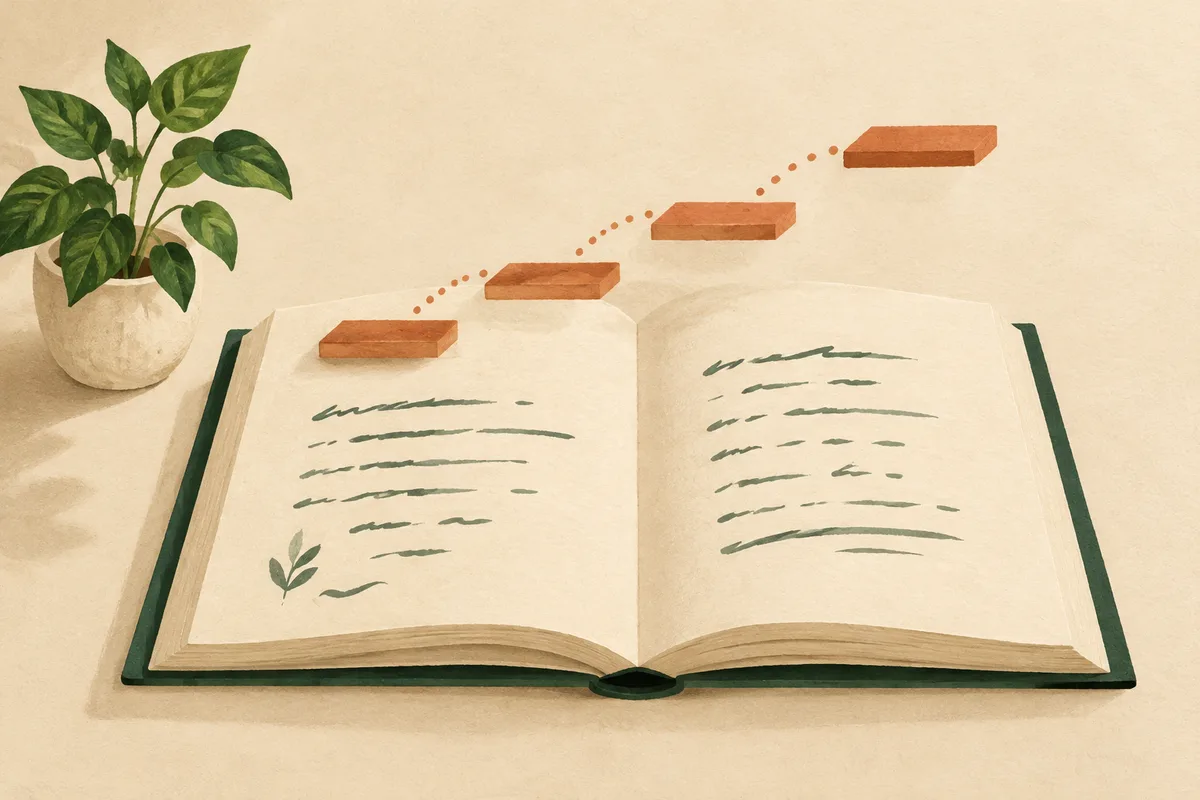
One dial per week: rhythm, landings, material, consolidation. Illustration, not measured data.
The Friday retest protocol
Same rules as the baseline: same test page, same material difficulty, same time of day, no warm-up lap. Compare:
- Pace up, quiz steady — keep the new pace as the floor for week 5's ladder.
- Pace up, quiz down — the gain was borrowed from comprehension. Step the target back 5% and hold it there for another week. The trade-off mechanics are in reading speed vs comprehension.
- Pace flat — check the quiz. If comprehension is fine, your baseline may simply have been accurate; extend the current week by a few sessions rather than forcing the dial.
One caveat that keeps all of this honest: a three-question check is a small sample. Treat each Friday as a signal, and judge the whole month on four Fridays together.
For Chinese and Japanese readers
The plan is identical; the unit and the week-2 work change. Pace ladders climb in 字/分钟, set on the Chinese reading speed test or the Japanese reading speed test. Week 2's phrase landings become 意群 for Chinese and 文節 for Japanese — in scripts without spaces, the guide-hop and the sense-group are the same exercise. Everything else, including the rollback rule, carries over unchanged.
After week 4
Three sane options, in order:
- Maintenance. Two sessions a week hold a gained pace; retest monthly.
- Another cycle. Same four weeks at the new baseline with harder material — the structure repeats, only the numbers move.
- Graduate to study reading. Fold the pace you built into a full method — the SQ3R reading method wraps a measured reading pass inside survey, questions, and self-testing.
If your material is your own rather than the reviewed library, practicing with your own articles keeps the measurement honest on any text you paste in.
Frequently asked questions
Can you actually increase reading speed in 4 weeks?
You can raise your measured baseline — typically by clearing drag (rereading, word-by-word voicing) and installing a phrase rhythm. Dramatic jumps like doubling your speed have not survived research scrutiny; a solid month of practice commonly moves workable pace by a modest, real margin. Your Friday retests will tell you your number.
How much speed can I gain in a month?
Honest answer: it depends on where you start. Readers with fixable habits — heavy rereading, single-word landings — often report 10–20% within a month. Treat that as practitioner experience, not a guarantee, and weigh it against your own comprehension scores.
How often should I train?
Four short sessions a week beats daily marathons. The skills are rhythmic and attentional; a rested tenth session is worth more than an exhausted seventh.
What pace should I set for each session?
Last week's held pace plus 5–10%, and only if the previous week's quiz stayed steady. The ladder is climbed from measurements, not ambition.
What if my comprehension drops mid-plan?
Step back 5% and hold. The plan's rule is that comprehension referees every gain — a pace you cannot comprehend at is not a pace you have.
Do I need to use the same passage every session?
Same difficulty, not the same text. Re-reading one memorized passage measures memory, not reading. Reviewed passages at a consistent level keep sessions comparable without becoming predictable.
Should I keep using the techniques after week 4?
Yes — phrase landings and forward-only reading are simply how trained readers read. The schedule ends; the habits are the point.
Four weeks, one dial at a time
The plan works because it is boring in the right places: one variable per week, small climbs, a retest every Friday, and a comprehension check with veto power. Start from a real baseline, climb in steps you can defend, and let four Fridays of data — not a promise — tell you what you gained.
Set your baseline now with a free reading speed test, and start week 1 tomorrow morning.