
What Is Chunking in Reading? How It Speeds Up Reading
Chunking in reading means taking in meaningful groups of words with each glance instead of fixating on every word. See how it works, what limits it, and how to train it.
Chunking in reading means taking in meaningful groups of words with each eye stop — phrases like "the lighthouse keeper" — instead of landing on every word separately. It is not a trick that pushes your eyes to sprint ahead of your understanding. It is a change in where your eyes pause: fewer stops per line, each one placed on a whole phrase rather than a single word.
If you watch your own eyes, they do not glide across a line of text. They jump and land, jump and land — and you only take in meaning while they are parked. Chunking trains those landings to line up with the units your brain actually wants: phrases and clauses. Here is what the research says about how the eyes move, why grouped landings raise speed, and how to practice chunking without giving comprehension back.

What chunking in reading is
Reading researchers have watched readers' eyes for a century, and the picture is consistent. The eyes stop — a fixation — for roughly 200–250 milliseconds, then flick to a new position with a saccade, typically covering 7–9 letter spaces in English. You are effectively blind during the jump; all uptake happens during the stops. A comprehensive review of two decades of eye-movement research summarizes these regularities in detail (Rayner, 1998).
A skilled reader's fixations do not fall neatly on every word. They land once or twice on short words, skip some short function words entirely, and their perceptual span — the region taken in around a fixation — reaches roughly 14–16 characters to the right of the landing point in English. In other words, fluent readers already take in groups. "Chunking" as deliberate practice means making that grouping conscious and aligned with meaning rather than leaving it to habit.
The word chunk comes from memory research, not eye research. George Miller's classic 1956 paper argued that working memory holds a small number of meaningful packages — chunks — rather than a fixed number of letters or items (Miller, 1956). Reading borrows the idea directly: if each eye stop delivers one meaningful package instead of one word, the same memory budget carries more of the sentence.
Why chunking raises speed
The arithmetic is simple. If a line holds about twelve words and your eyes stop on every word, that is twelve stops. If each stop takes in a two-to-four-word phrase, the same line needs four to six stops — and since only the stops consume time, fewer well-placed stops directly raise pace.
The bigger gain is not mechanical, though. Phrase-sized stops match the units your brain parses anyway: subjects, verb phrases, clauses. Reading in those units means each fixation hands your working memory a ready-made piece of meaning, which frees attention for the sentence instead of reassembling words. As a side effect, phrase-level landings also quiet word-by-word inner voicing — the habit covered in what is subvocalization.
What chunking does not do is raise your reading speed ceiling on hard material. On dense text with unfamiliar vocabulary, your usable chunk shrinks no matter how your eyes are trained. The technique raises your floor on ordinary prose; your ceiling stays gated by language knowledge and comprehension.
How to train chunked reading
Four practices cover most of what you need. None requires special software.
1. Let punctuation do the chunking first
Commas, dashes, and sentence boundaries are pre-marked chunks. For a few sessions, deliberately read clause by clause: one easy stop per comma-separated group, a full stop at each period. This builds the rhythm before you shrink the chunks below punctuation level.
2. Aim landings at phrase centers
Instead of fixating the first word of a group, aim your landing near the middle of a two-to-four-word phrase, a little left of where you would normally look. The perceptual span does the rest. If it helps while retraining, let a fingertip or pen sweep in smooth phrase-sized steps — it is a training aid, not a dependency.
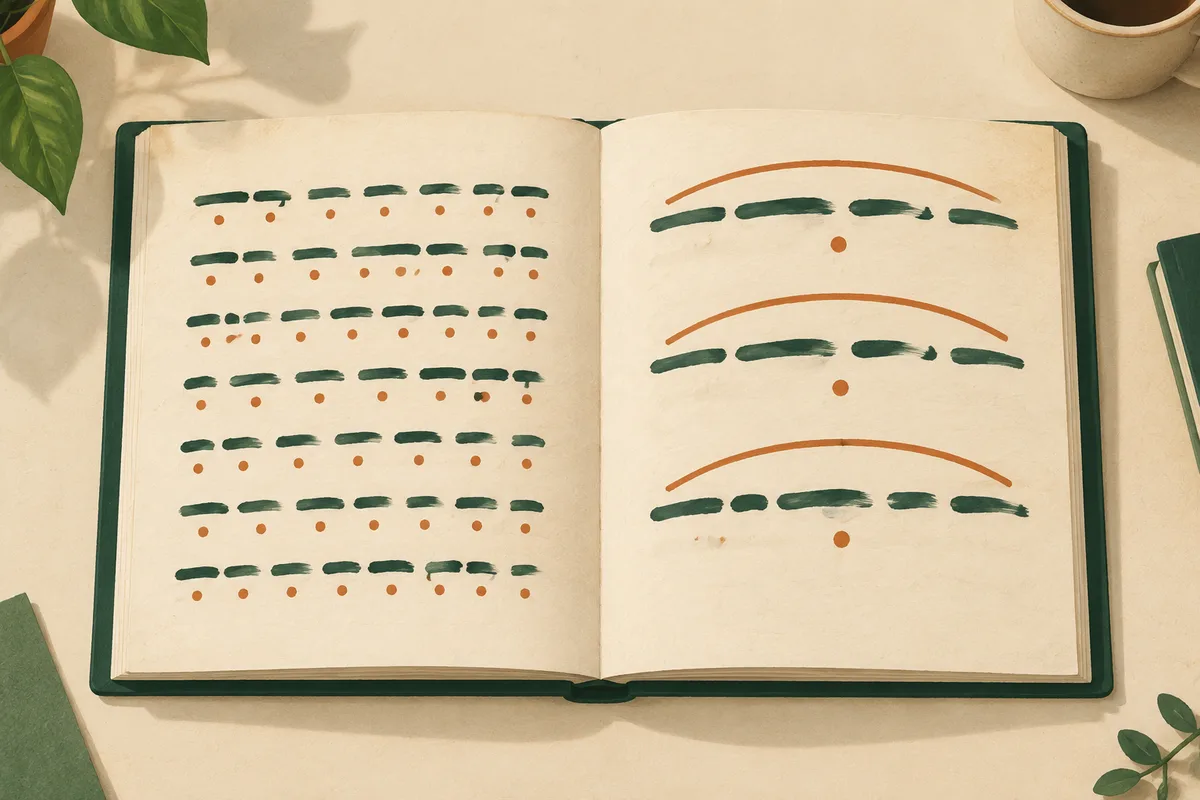
Left: a stop for every word. Right: one stop per phrase group. Illustration, not eye-tracking data.
3. Practice against the clock at a slightly raised pace
Run short timed sessions at 10–15% above your comfortable rate in a paced reader — word mode at a set pace, or sentence mode if you want clause-sized units delivered for you. The mild pressure makes word-by-word stops hard to sustain. Slow back down the moment comprehension wobbles. If you want the practice loop with material you actually need to read, the guide to practicing with your own articles shows how to paste in any text and keep the measurement honest.
4. Check comprehension every session
A faster feeling without a comprehension check is only a feeling. Close each session by summarizing the passage in a sentence or answering a few questions. Reading speed vs comprehension explains why the quiz result, not the pace number, decides whether a new pace is real.
What limits chunk size
Chunk size is not a muscle you can grow indefinitely. It shrinks and grows with the material:
- Vocabulary and syntax. Unfamiliar words and long nested sentences force smaller groups and more stops. That is appropriate, not a failure.
- Language level. For second-language readers, the usable span grows with vocabulary breadth — there is no shortcut around knowing the words.
- Purpose. Studying for recall legitimately uses smaller chunks and more stops than skimming a familiar update.
Forcing a wide span over difficult text produces fluent-looking eye movements and poor recall. If your quiz scores drop when you widen chunks, the chunks are too wide — the honest signal is in the check, not the eyes.
Chunking in Chinese and Japanese
Chunking looks different in languages without spaces between words — and it matters even more there.
Chinese. Text runs in characters with no spaces, so the reader supplies the segmentation. Fluent Chinese readers group characters into two-to-four-character words and phrase units — 意群, "sense groups" — and each eye stop typically covers one such unit. Training yourself to see 意群 boundaries, rather than stopping per character, is the Chinese version of the same skill.
Japanese. The natural unit is the bunsetsu — a content word plus its attached particles — and fluent readers chunk text in exactly those units. Kanji compounds help: a four-kanji compound is one glance, not four.
Because both languages are measured in characters rather than words, progress shows up as CPM — characters per minute. An English WPM figure cannot be relabeled as CPM. The Chinese reading speed test measures CPM on reviewed passages, so you can baseline chunked reading in your own language.
Where chunking fits in a full study pass
Chunked reading is a pace technique, not a study plan by itself. For textbook work it slots into the read step of a structured method — our SQ3R guide shows how a fast survey, heading questions, and self-testing wrap around the chunked reading pass.
How to tell if it is working
Measure it, in three steps:
- Run a baseline session on material of typical difficulty and note your WPM or CPM and quiz result.
- Practice chunked reading for a week — punctuation-first, phrase-centered landings, timed sessions.
- Retest on comparable material and compare both numbers.
If pace rises and the quiz holds, keep it. If the quiz drops, your chunks outran your vocabulary — narrow them and rebuild. Three quiz questions are a small sample, so treat the result as a signal, not a grade. A free reading speed test gives you the baseline and the retest on reviewed passages.
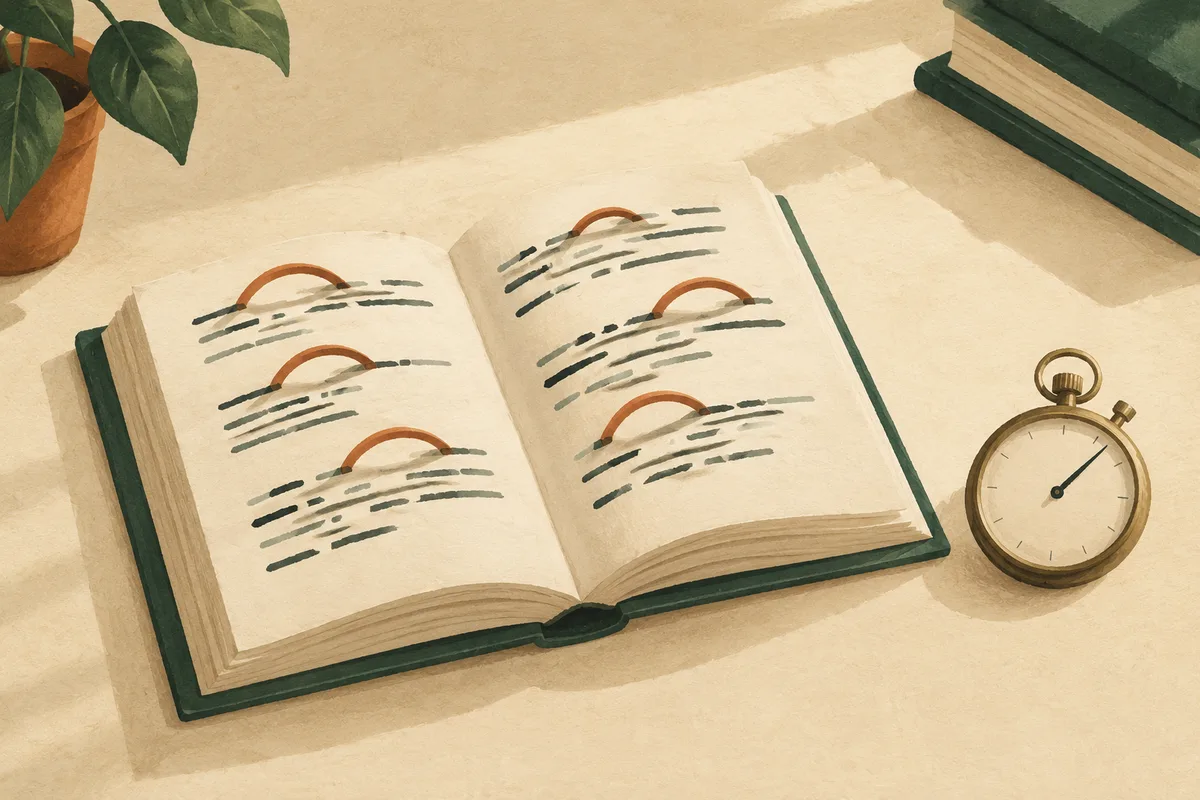
Timed sessions at a slightly raised pace are where chunking becomes habit. Illustration, not measured data.
Frequently asked questions
What is chunking in reading?
It is the practice of taking in meaningful groups of words — phrases or clauses — with each eye stop, instead of fixating every word separately. Skilled readers do it naturally; training makes it deliberate.
How many words should a chunk be?
Two to four words is a workable range for English prose, tuned by difficulty. Difficult text legitimately shrinks the chunk; easy prose allows wider groups. There is no single correct size — comprehension sets the limit.
Does chunking really increase reading speed?
Yes, on ordinary prose: fewer fixations per line means less time spent parked, and phrase-sized uptake matches how working memory handles language. Gains on difficult material are smaller because unfamiliar words force more stops regardless of technique.
Is chunking bad for comprehension?
Not when the chunk matches your language level. Comprehension suffers only when you force groups wider than the material allows — which is why every practice session should end with a check.
Can you chunk Chinese and Japanese text?
Yes, and it is the core skill there. Chinese readers chunk characters into 意群 (sense groups); Japanese readers chunk by bunsetsu. Because these languages count characters, progress is measured in CPM, not WPM.
How long does chunking take to feel natural?
Most readers need a few weeks of short, regular sessions before phrase landings stop feeling forced. Treat that as a common experience, not a research figure — the retest, not the calendar, tells you when it has stuck.
Is chunking the same as skimming?
No. Skimming searches for gist and skips content. Chunking reads everything, just in fewer, better-placed stops. You still take in every phrase — you simply stop for groups instead of words.
Fewer stops, same understanding
Chunking is not about pushing your eyes faster; it is about wasting fewer stops. Read clause by clause until the rhythm is familiar, aim your landings at phrase centers, keep sessions slightly timed, and let a comprehension check referee every gain.
Start with a free reading speed test, note your baseline, and give the technique one honest week before you judge it.